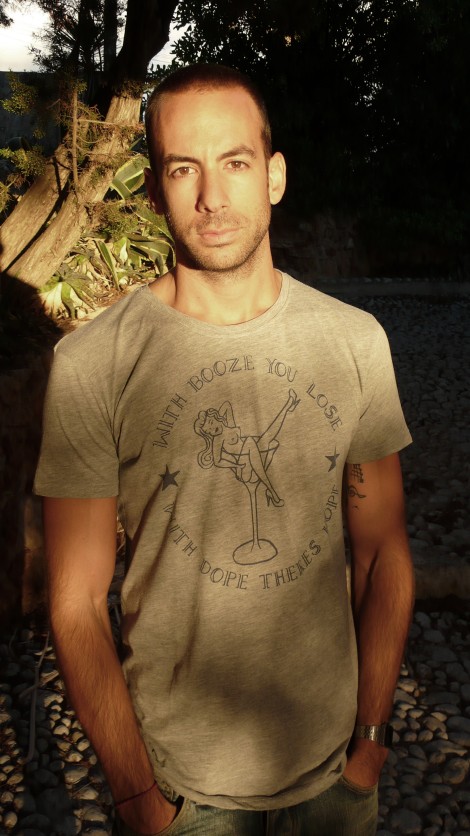
Interview by adlet, March 2014. Translated from Czech for international readers.
In just three weeks, Spanish DJ and producer Julian Perez — a representative of Fathers & Sons Production and close collaborator of tINI — will appear in Prague for the very first time. This young talented DJ from Ibiza has made a name for himself with original tracks and high-quality dance sets at events like WMC Miami, playing alongside names such as tINI and Steve Lawler.
How are you at the beginning of spring? Are you busy?
The beginning of spring is being great. I'm still in Miami after WMC, so I'm having a good one, chilling before going back to Europe next week. Yeah, always busy — loads of new projects and stuff to do, which is a good thing. Trying to organize myself to make them all on time.
It's your first time in Prague. Have you heard about the Czech electronic scene?
I haven't heard so much about it, so I'm looking forward to checking it out by myself in May. Curious to be in one of the most beautiful cities in the world — I've just read it in a ranking. I'll fly early in the morning so I'll have time to see around.
As a Spanish DJ, how did you get the attention of a Berlin agency?
It's a mix of everything. It's a very exclusive agency and yeah, I think I'm the only Spanish artist in there. I needed a proper agency and it showed up at the right time. It was more than my relation to records that got their attention. To be the kind of artist they were looking for makes me work even harder, because the level is high. It's a good challenge.
How did you start collaborating with tINI?
She is such a cool girl! I don't really remember where and when we met for the first time but it worked well between us from the start. She is always playing and supporting my music and the releases on Fathers & Sons, she really digs it. I love her energy and taste when playing — she is without doubt one of the new most talented DJ women out there. We'll be playing together a few shows this year.
How long did it take you to produce your first track? Was it hard to get it released?
When you are a DJ trying to start producing, releasing the first track is something you really want badly. You can't wait to hear feedback from other DJs after many attempts to do something decent. The first track I released was my project Nº19. It took a couple of days to create the idea, and another couple to try to get the best sound from my inexperience. It was released 5 months after the first trial. I think I never sent anyone my first 18 attempts. It's important to be patient, even if that's not one of my virtues. After some time you become more selective.
You have a classic analog sound. What are your studio favourites?
What you feel in my production is more about the character of the track than the equipment used to make it. It's a touch of the '90s, because that's the sound I grew up with, and logically all its influences are present in my production — which is why I use a lot of classic samples. My studio favourites are Roland TR-909, TR-606 and TB-303 (belonging to my neighbour), Jomox XBASE 999, MFB 522, Tempest and Korg MS2000 for vintage synth. Then I use an MPC3000, an analog 24-channel mixer and external effects.
Your own label releases only on vinyl. What's the main reason?
The reason is sharing a piece of music — something you can collect the same way we used to. Music that was created to be pressed on a record and listened to in that format. It keeps it close to people who truly appreciate it.
It's great that everyone can enjoy music digitally too, but if you have a label that pursues that format for production and sales, you can't control how widely the track spreads. Then everyone can play it, so it's far too easy to get and it won't get the attention from DJs like me. Also, producing tracks for vinyl matters — if a track is produced and mastered fully digitally, it will still sound digital in analog format. In such cases I'd rather buy the digital version than the vinyl.
What's it like when DJs like Loco Dice or Ricardo Villalobos play your music?
Those are the things that make you feel great and fired up to keep working. Who wouldn't imagine their favourite DJ playing your latest freshly-made track with the crowd going crazy? That's the classic dream.
How do you start sets in cities where you've never played before?
I never arrive with a plan of what I'll play in a city I haven't been to. I come to the club fairly early to listen to the resident DJs and then start my set in my own way, feeling it as I go and watching the reactions. When people are open to diving into it, it always works.
Can you tell us something about the scene in Ibiza? Underground or commercial?
Ibiza itself is commercial — truthfully there is no underground scene there. But if you're talking about a classic party with normal prices, where promoters aren't only thinking about making money and people come who simply want to enjoy the music rather than watch famous DJs they don't even know — you can find those. But not on billboards or flyers. Those are definitely not underground.
Original article
